Time out Tuesday (extra!extra! edition): Looking back on Iraq
Having lived through half a decade of living with the war in Iraq on the public conscience (for some of us that's all of high school or college) and upon the cusp of a sixth year... two questions come to mind: 1. What happened to the Afghanistan war? 2. What happened and what can we learn?
Here's a few of the stories I've been looking at while trying to find an answer...
 MediaStorm's teamed up with Reuters for their latest collaboration, and produced a piece that looks at what experiencing war has meant for those reporters charged with the task of documenting history. "This is their testimony - bearing witness to ensure the story of Iraq is not lost." Very powerful, not to be missed.
 MSNBC created an interactive timeline that looks at the key military and political moments from Colin Powell's UN speech in which he presented the US's reasons for seeking approval for military actions to Saddam's down fall and trial to Blackwater employees gunning down Iraqi civilians to a surge of US troops that is reported to be working. With videos for many of the key events instantly available in a pop-up slider, it's the best time line I've found yet. If only history books came this way.
 Over at Magnum, they've decided to approach the topic with "WARS" a four part essay series that takes the work of Philip Jones Griffiths (RIP) in Vietnam, Christopher Anderson in the Middle East, Thomas Dworzak in Chechnya and Iraq and Paolo Pellegrin in Lebanon. With pictures, commentary and a slick design, WARS is one to watch and there are plans for future installments to the series, so stay tuned. (P.S. Hey Magnum, 2003 called they want you to add an RSS feed!)
 I have a soft spot for cartoonist, in particular political cartoonist, which I'm sure is because for a time I gave it a go to create my own comic strips and spent a semester creating a few political cartoons for the college paper. Plus as a kid they were my first exposure to newspapers as I used to read after my dad was done with the paper, and you never forget your first. Cartoonist have always been the unsung contributors to newspapers, summing up the days hot topics in one panel and sometimes ending up on Nixon's enemies list or invoking the wrath of the Pentagon among other things (ever see Zodiac, they sometimes even become investigative journalist). Take a look at over a 1000 political cartoons on the Iraq war.
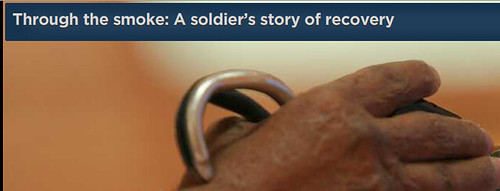 "Through the smoke: A soldier's story of recovery" was created last year for the fourth anniversary and comes from the family of a soldier where he speaks in his own voice on what his recovery was like. Where the pictures may lack in variety and impact (and I'm speaking in PJ terms here so don't get your panties in a bunch Stella) his voice makes up for it.
 In another MSNBC piece, a wife, a father, a family looks at the life, military service and death in battle of Spc. Anthony A. Kaiser. "As America contemplates the almost 4,000 U.S. soldiers killed in the conflict in Iraq, one family reflects on the life, service and legacy of their lost loved one."
*Time out Tuesdays is back on SLR for a while, until MultimediaShooter.com gets all the kinks worked out and I can start posting over there again.
Here's a few of the stories I've been looking at while trying to find an answer...
MediaStorm's teamed up with Reuters for their latest collaboration, and produced a piece that looks at what experiencing war has meant for those reporters charged with the task of documenting history. "This is their testimony - bearing witness to ensure the story of Iraq is not lost." Very powerful, not to be missed. MSNBC created an interactive timeline that looks at the key military and political moments from Colin Powell's UN speech in which he presented the US's reasons for seeking approval for military actions to Saddam's down fall and trial to Blackwater employees gunning down Iraqi civilians to a surge of US troops that is reported to be working. With videos for many of the key events instantly available in a pop-up slider, it's the best time line I've found yet. If only history books came this way. Over at Magnum, they've decided to approach the topic with "WARS" a four part essay series that takes the work of Philip Jones Griffiths (RIP) in Vietnam, Christopher Anderson in the Middle East, Thomas Dworzak in Chechnya and Iraq and Paolo Pellegrin in Lebanon. With pictures, commentary and a slick design, WARS is one to watch and there are plans for future installments to the series, so stay tuned. (P.S. Hey Magnum, 2003 called they want you to add an RSS feed!) "Through the smoke: A soldier's story of recovery" was created last year for the fourth anniversary and comes from the family of a soldier where he speaks in his own voice on what his recovery was like. Where the pictures may lack in variety and impact (and I'm speaking in PJ terms here so don't get your panties in a bunch Stella) his voice makes up for it. In another MSNBC piece, a wife, a father, a family looks at the life, military service and death in battle of Spc. Anthony A. Kaiser. "As America contemplates the almost 4,000 U.S. soldiers killed in the conflict in Iraq, one family reflects on the life, service and legacy of their lost loved one."*Time out Tuesdays is back on SLR for a while, until MultimediaShooter.com gets all the kinks worked out and I can start posting over there again.
Labels: government, history, multimedia, news, time out tuesdays, video inspiration
posted by S. Dulai at 2:13 AM
|




 Latest from SDulai.Newsvine.com


