Thursday, September 06, 2007

What is truth?

As journalist, our stories go into the paper and inform the public today, but in time it becomes history and if that history is built on lies, then we become a nation of lies.

But how do we define truth and when does something become truth? We once believed that using leeches as a medical remedy was a truth. Weapons of mass destruction were sold as a truth. Up to a few weeks ago scientist had to reexamine the truth of dark matter.

I don't have a simple answer to this, this is just the type of fascinating stuff that I like to think about (other topics include: How is memory stored in the brain, will nano technology lead to cameras we can wear over our eyes and fire by blinking and how do they get those widgets into cans of Guinness?)

I think it's important to think about these things, especially as journalist we have a gatekeeper's responsibility to ask the sometimes rude questions and pursue every angle so that truth will emerge.

We have no other choice but to get it right and get it right the first time, and if you think otherwise, perhaps you should look into another line of work. For one, fiction pays more.

War and Truth is a recent documentary that looks into the history of war, from WWII to today and examines the way we cover it, what our government controls and how truth and history is shaped by these actions.

And unlike Fahrenheit 9/11 or OutFoxed or Fahrenhype 9/11 it tries to do so in a balanced approach where truth is paramount and no judgment is made on the part of the film. (Also see Why we Fight, Fog of War and Capturing the Friedmans if you're into good journalistic documentaries done right.)

And it doesn't pull any punches: "If people are going to vote for war and we are gonna put this nation at war, we ought to know something about it," says Roger Peterson, former ABC coorespondant who was seriously injured in Vietnam, in the film. (Bonus: Ted Koppel name drops him in this excellent speech to the Overseas Press Club.)

The focus of the film is journalist and how war is covered. They speak with journalist from every era and from all sides, from the mainstream free press to the internal military press. It also asks why this is important, for journalist to take such large risks to do the job. According to Committee to Protect Journalists 112 journalist have been killed in Iraq as of today (10 more since the May 07 statistics the film uses).

There has to be a reason why we do this.

One more thing, Helen Thomas is a firecracker. I've never felt compelled to reference the 40s and call anyone a "fire cracker" before, but there you are. She's a firecracker.

Other's have also examined the essence of truth.

Steven Colbert (yeah like his ego needs a link) has made a career out of coining words like truthiness.

The Washington Post's Baghdad bureau chief Rajiv Chandrasekaran wrote all about his struggle to report on Iraq in the book "Imperial Life in the Emerald City."

Sig Christenson of the San Antonio Express-News recently wrote a commentary on his struggles and frustrations with both sides, but in particular he takes journalist to task for not asking those tough questions and questioning the given truths.

Last week I was listening to NPR and tuned into to an engaging hour with Paul Watson, and his story of the 1994 Pulitizer Prize winning photograph (warning, the image is very graphic, otherwise I would not be linking to it instead of posting it) of a dead American soldier being dragged through the streets of Mogadishu,Somalia that still haunts him.

I can't mention everything, but one thing in his story what struck a cord was his reality of what images the Pentagon, wire services and newspapers would allow and reject and thus in turn how this would shape the history of events. In once instance he moved some images of American soldiers whose body parts were being flung about, they didn't run but the word was out and questions were being asked. According to Watson, the Pentagon denied it as truth and claimed it never happened, in turn this became the new truth of the events.

I can't recommend it enough, you should give it a listen, it's very good.

Even Dr. Seuss was shaping the message as a political cartoonist for New York City's tabloid magazine "PM" during WWII.
Dr. Seuss may be a surprise, but it shouldn't be. Political cartoonist are often at the forefront of challenging norms and asking the tough questions.

Its a topic Professor Dennis Dunleavy has been examining in relation to the current war. In his research (which I guess he hasn't published yet) he's found that in the case of Iraq and in particular Guantanamo Bay, it was the daily newspaper cartoonist who were challenging our excepted truths.

The nature of truth is a very delicate balance. As journalist we are taught to inform and present our findings without any sign or hint of an opinion. There's a very obvious reason for this, one that I hope should be very clear and evident by now.

Labels: , , , , , , ,

Thursday, May 17, 2007

Asian Representations in American Cinema Developed for a Teenage Audience or Why Doesn’t Anyone Look Like Me?

In another life I spent more than a few years writing film reviews and essays of new and old, classic and infamous, good and bad films for various websites and any press outlets that would have me.

Recently I had the chance to revisit my old passion when it came time to produce a research paper in one of my classes in the Film department at San Jose State University. What follows is that research paper and given this past year of Rossie O'Donnel's incredibly flippant impression to the flame up around Don Imus (why are you hovering over his name? Do you really need a hyperlink?) to just tons of insanity, it's clear to me the topic of my paper is timely to the discussion and I thought it was an interesting enough topic to post here.

Asian Representations in American Cinema Developed for a Teenage Audience
or
Why Doesn’t Anyone Look Like Me?


Teens films came into their own in the 1950s but they’ve only become truly representative of the teenage cultural landscape until fairly recently, arguably making leaps and bounds at an accelerated pace in the last ten years with films like 2000’s “The Debut”, 2002’s “Better Luck Tomorrow” and ultimately culminating in 2004’s “Harold and Kumar go to White Castle,” the stoner comedy that did more to tear down conventional norms and dismantle stereotype then any other film before or since.

In this class we have, over the course of the semester, we have “analyzed how motion pictures have depicted teenage culture throughout history and in a number of cultural contexts,” however we have overlooked one major cultural context as we journeyed through the 1950s to today.

What has been lacking is any portrayal of Asian-American’s on screen. We did have “Crazed Fruit,” a New Wave Japanese film that looked at adolescence and coming of age, but it looked at growing up in Japan from a Japanese perspective and had little to do with American culture or the Asian teenager growing up in America.

For the most part, Asian characters have been caricatures of the real thing in films such as the Charlie Chan franchise, in subservient roles such as in films like “Short Circuit” or shows like “Happy Days,” diluted icons to be oversimplified and made digestible for a mainstream white audience such as in the film “The Karate Kid” or on the show “Kung Fu,” or they are walking stereotypes obsessed with sex, western culture and mathematics on shows like “Seinfeld” and films like “Sixteen Candles.”

As a whole, fully realized and developed representations of Asian-American teens, even Asian-Americans in general for that matter (how many times have we heard Jackie Chan complain of the offers he gets for roles or for that matter how many Asian-American’s do we see on screen that are not women on white men’s arms?), have not existed in the mainstream.

In what follows I will examine the portrayal of Asian-American’s in cinema and chart the progression of the portrayal of this culture in the larger subculture of teen films as defined in the class using 2000’s “The Debut”, 2002’s “Better Luck Tomorrow” and 2004’s “Harold and Kumar go to White Castle,” as examples to illustrate my point.

Just as the world was ringing in the new millennium a little film from a collaboration of ethnic filmmakers was setting out to promote and release their film, appropriately titled “The Debut.”

The story was a fairly simple telling of a pair of Pilipino-American teenagers coming of age in San Francisco and focused on one night in the life of high school student Ben Mercado (Dante Basco, of “Hook” fame).

Ben like many Asian-American’s was trying to assimilate in the MTV dictated culture that surrounds him and would rather play basketball, listen to hip-hop, go out with his friends and avoid at all costs his family’s traditional ways and cooking. So when his sister’s traditional coming of age Debut party comes around, it becomes one night of discovery and cultural battles that force Ben to examine who he is.

Pretty much a by the books story arc of alienation and coming to terms with who you are when growing up, but it was monumental for the progression of Asian-American’s on scene by showing that there are issues that Asian-American’s deal with that are just as important as the issues that Tom Cruise, Kid n’ Play and John Travolta dealt with in other mainstream films.

This film opened the door to the idea that Asian-American teens also deal with the same alienation and coming of age that white teenagers do and as it became the first Pilipino-American film it also proved through its grassroots campaign that there was an audience for teen films that included Asian-American’s in the discussion.

It was a small but important step in opening the door and open the door it did, because two years later newly established MTV Films was looking to sign their first film as a production house and distributor and selected Justin Lin’s “Better Luck Tomorrow” to lunch their label.

It was a bold move on the part of MTV Films and many questioned if they were making the right move, most famously the story goes that after its premier at Sundance, and just before MTV Films picked it up, many in the audience lambasted the director and producers for portraying Asian-Americans on the screen in such a light. Some wondered why they had to be shown in such harsh light and others questioned if it was ethical and even moral to show them in negative ways that were less than ideal and accused the director of being irresponsible to his culture.

One wonders if these same outspoken detractors would lay the same claims at the feet of similar films staring white teenagers, such as in “American History X,” or black teenagers, for example “Menace II Society”

As I’ve only hinted at thus far, the plot did cast Asian-American’s in a brutal light, by turning the accepted ideal of the Asian-American overachiever with a laser-like fix on college entrance exams and quadratic equations into a criminally fascinated and sometimes violent teenager on the verge of entering adulthood and fighting to define it on there terms.

The film harkened back to the violent Caucasian teenagers of rebellious 1950s teenage films like “Rebel without a Cause” and recast the players and moved beyond the stereotype to ask: Aren’t Asian-American’s just like everybody else? Why should Asian-American’s on film be any different? And isn’t this just as valid as any other teleplay of white or black teenagers?

“Harold and Kumar” built on the progress that “Better Luck Tomorrow” had made in turning the Asian-American stereotype on its head two years after that film had come and gone from theaters and the cinema’s collective debates. The film even managed to work in a reference to the previous film, when a bully taunts Harold (John Cho, who also stared in “Better Luck Tomorrow”) by referencing the title of that film.

Right from its first scene it is established that this is not going to be your average teen film with the introduction of white males that exit the film like any other comedy of this flavor, but then the camera doesn’t follow them, it stay on Harold. And it becomes a teen movie that for the studio will make money, but for the community will make stride, and while the characters may be two 20-something roommates on the road track to careers and midlife crisis, the audience is clearly the teenager.

It’s surprising to learn that it took two white men to helm the project and stick to their guns against studio pressure for ethnic casting for the leads, but regardless of that, “Harold and Kumar” was loaded with clever jabs at stereotypes, for instance just before the end credits, caricatures of a man in a turban and another in a traditional straw hat are shown on a wanted poster. In another scene the film “Sixteen Candles” is discussed, which has a very stereotypical portrayal of Asians and is cleverly contrasted, for those familiar with the film, to the Asian face we see in this film nearly 20 years later.

At another point, Kumar goes into a speech about the American dream and how it is their right and duty to get the food they seek and devour it in the name of every ancestor and minority that has struggled to be equal with the accepted mainstream majority. Harold and Kumar’s strife and desires are no less worthy of a film than the white men that peeled out of the lobby in the opening credits.

This attacks societies accepted norms of different people and causes an audience who has just spent nearly two hours with these characters to reflect and rethink their notions of what they think of Asian-Americans.

In many scenes the image of the studious Asian-American is turned upside down with wild parties and rambunctious exploits and in others the manly dominate white males are recast as weak effeminate men that puff their chest at any threat to their dominance.

At the time the film became a box office boon for the studio, but in hindsight, “Harold and Kumar” is more than another stoner film, like Cheech and Chong before them, Harold and Kumar challenged societies accepted norms and through means of easily digestible and packaged delivery got in people’s faces about what they believe and the stereotypes they carry with them about Asian-American’s.

These films collectively have gone a long way in putting Asian-American’s on the screen and giving these teenagers a familiar face and teen movies in general a more accurate representation of the current American landscape.

Today it is becoming more common to see Asian characters in films, if only in minor roles at the moment, but at least we are speaking now next to the white leads instead of just serving them lunch or waiting to fix their girlfriend’s computer before the big dance.

There is still a long way to go. As I have shown here, the truly milestone films have only shown up once every two years and since 2004 there have been no major Asian-American’s on TV or Film. Hopefully that will change as the idea of Asian-American’s in media become more of the norm than exception among studio project proposals and as young Asian-American teenagers of today go on to become the adult Asian-American consumers of tomorrow.

Labels: , , , , ,

Wednesday, April 18, 2007

My favorite MC is Escher!

I've been a little too serious as of late around here, it's time for some comedy relief.

Animation and MC Escher... I love this kinda stuff.

The fellow shaving his head has unwittingly created something that every multimedia photographer is striving for: short, sweet, tightly edited, has a perfectly accentuated musical aspect and it holds our attention.


MC Escher is just plain cool, and this video picks up on the line draw craze and uplifts it to an art form.

Labels: , , , , , , ,

Friday, April 13, 2007

Multimedia Shooter contest winners

I've been meaning to post this for a while, but someone cruel once decided that humans need sleep.

If you're like me you're always looking for inspiration and one of the places I've found it was in looking over the winners of Multimedia Shooter's first anything-goes contest held last March.

There's a couple of really good pieces, some just off the wall (and just my type of humor), one very short Mark II envy-inducing clip (Canon are you listening?) and even one from some friends to the north.

Enjoy!

Here's hoping Richard has a chance to thrown another one of these. I'd love to see what my peers and "photo gods" are cooking up.

Labels: , , , , , , , , , , , , ,

Light bent on itself?!

According to a report by Scientific America, researchers have developed a method of refracting light back on itself in the opposite direction than how it wants to natural bounce off a surface.

What's this mean, it's means there's some crazy stuff going on with the study of light and adjusant to that is the way we see.

The obvious application for this would be a cloaking devices for military applications, but I'm not interested in that.

I wonder what, if anything, this means for photography?

Another area of research involved the ability of certain materials to amplify light to make even the faintest of objects come in more clearly.

Given enough research and development this could mean greater ISO sensitivity and sharper images, and if adapted properly it could mean more accurate replication of film ISO, because in everything I have seen digital ISO and film ISO are not 1:1 equivalents and as great as high ISOs appear from a Mark II, it's never quite looked like the film counterparts that I learned with.

It could also mean better performance in low light situations. It's all very experimental and as of now the research is not aimed at photography, although I am sure it will be used in astronomy very soon.

Light fascinates me, so maybe I'm stretching to relate it to photography (why did I call this blog 'SLR'.. oh right, I thought it was clever), but this is some interesting research. Maybe we'll get some sort of new film stock out of this that will let us capture the world in new ways.

Even infrared was first developed as a scientific tool, and look at where that went. (Which reminds me, is solarizing a print a lost art?)

Labels: , , , , , ,

Wednesday, March 21, 2007

Cuban Streets and Latin Beats

When Mediastorm launched a little over a year ago one of the centerpieces was "1976" a project that fused the beats of DJ RJD2 with a street photography aesthetic and an amazing flair for style and visuals.


It's more music video than journalism, but it's just to good to ignore. I recently came across it again and thought why not share.

Back then, pretty much every photographer I talked to was talking about 1976, if you haven't seen it, do it now!

Labels: , , , ,

Sunday, March 04, 2007

Writing for the silver screen (by osmosis)

This year I got to take part in something I've been wanting to for a long time. It's another one of those things that I've always wanted to do but never knew when the plan would come to fruition.

But it's funny how the last couple months things that I've always wanted to do have been coming my way. (Lorne Michaels if you're reading this, come'on!)

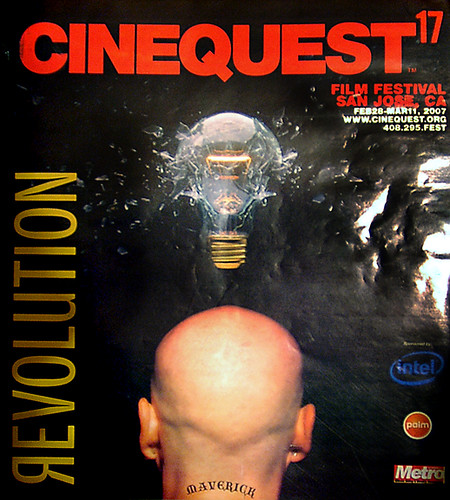
If you open this program for the Cinequest Film Festival, you'll find stuff written by me inside... and no it's not like last years where I ran around town with a Sharpie... (just kidding boss!)

I tell myself I'm not a writer and that I only want to focus on honing my photographic skills. The way I reason it, if I split my focus between two disciplines, neither one will improve, but if I pick one and pour myself into it, then I'll excel. But then I get the opportunity to do things I just can't say no to.

Last summer I was brought aboard Cinequest, a top 10 rated film festival right out of San Jose, as an intern. My task, to fall back into my film critic role from bygone years and help write the program for this years festival.

I spent the last several months watching films late into the night, jotting down notes incessantly and then condensing my assesments into digestible nuggets for the program guide. Which was first published in the San Jose Metro in January and began appearing last week in it's glossy covered standalone version, and it's in full color for the first time!

Cinequest 2007 runs from Feb 28 - March 11, pick up a program and let me know if I was right or wrong.

Labels: , , ,