Thursday, October 04, 2007

Burma protest

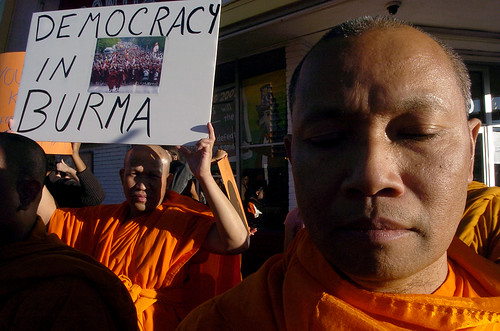
If you're a photographer and have paid even the slightest sliver of attention to world events, you've no doubt heard of what is happening in Burma and most likely you've heard of or seen images of Kenji Nagai, 50, the Japanese photographer who was working for Tokyo-based video and photo agency APF News, that was allegedly shot and killed by Burmese troops cracking down on anti-government demonstrations in Rangoon.

And to a lesser extent you may have read something about the German photographer, and the stories of reporters meeting a similar fate.

Why is it that journalist have become the target in recent times? In Lebanon a new trend of kidnapping journalist emerged and since then, in one world conflict after another it seems that journalists are behind the cross hairs on both sides?

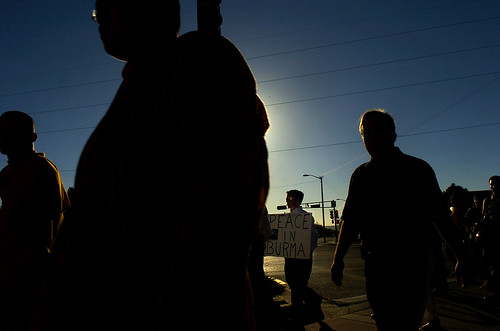
I don't really know what the answer is, it's just what I was thinking about before, during and after a recent assignment in which I was covering a silent protest lead by a local group of monks.

It was a strange assignment, not so much in what I was doing but what I was hearing.


Random folks along the path the protesters walked were making comments that weren't the most culturally sensitive or enlightened.


One of the lighter ones: "What is this, the Dharma inisitive?" Which was followed by laughter from a table on the patio at Starbucks.

That was one of the lighter ones.


But it reminded me that people like those at the table do still exist and stories like this one in the newspaper will hopefully inform some of them to what is really going on.

I felt what we always like to feel as photographers, that our images make a difference. Perhaps they will see the images and in their curiosity read the caption and then the story and the next time they see one of the monks or protesters walk by they might say: "I understand you."

Labels: , , , ,

Saturday, September 01, 2007

Who needs the Kwik-E-Mart?

*Warning! Today's post deals with some intense social issues and may not be suitable for anyone. If you're hoping for the usual zany post on SLR today, I'm afraid this one isn't it. It started out that way, but didn't end up that way. I have hesitated publishing this for some time, afraid that my message would be lost in the delivery, but today I've decided to post it...

Back in the Bay Area before the Simpson's Movie came out, there was a 7-11 promotion which had designed some stores to look like Kwik-E-Mart.

I got a chance to very quickly stop and take a look and... A part of me would be offended... but darn it, it's the Simpson's and it's just to cool!

I especially like the attention to details, like the Krusty O's and Buzz Cola.

I won't go into how Apu has become the face of Indian-Americans, or East Asians, or Eastern Middle Eastern or South Asians, or sand ni**ers (yes, I've been called that) or Fazians or whatever you guys are calling us this week.

Or how much that sucked growing up, having our only identifiable image in the media be a sterotypical 7-11 store clerk who lives and dies by his store and its sky high prices and can achieve that American Dream of hard rock, fast times and a Trans-Am if only he can sell one more slushed ice drink while avoiding being shot one to many times (50cent has nothing on Apu... I wonder if his name has anything to do with the Apu Trilogy).

Haha, I sell Slurpies and work at 7-11, it is to laugh. Haha. (And your dad sits on a couch all day looking in the cushions for loose change for those Slurpies while he has to constantly remind himself that your sister is off-limits but you're okay. But lucky for you, because tonight he's to drunk on moonshine he made in the tub out of an assortment of whatever was under the sink to get up and do anything to you... whoa whoa whoa! I gotta be careful, there could be children reading this.)

Thanks Apu for keeping that image alive, I know it was tough with the LA Riots and the Korean grocery store clerk from "Menace II Society" and that fat guy from New Jersey challenging your store clerk dominance, but you persevered.

He's our most identifiable personality, and he's animated to boot! WTF?!

I remember the first time I saw an Indian person on TV, seriously, I was 11 or 12 and it was a Saturday and a commercial for AT&T came on and in it an Indian grandfather in India was talking to his grandson in America. I remember it in that much detail, it was that monumental for an 11-year-old to see someone that looked like him on TV.

Years later CNet would have a series of ads with an Indian man in a yellow shirt helping people find tech answers... but of course now we're just in another service role and another stereotype. Before that there was Short Circuit (or maybe the sequel) that had an Indian character and since then all we've gotten is Kal Penn (what? Penn, you know Penn... sigh, Kumar) and M. Night Shyamalan. (Way to go "the next Spielberg"... hey you wanna know something, Steve's secret is good source material. If you can't write it yourself just make a movie from a book like all the greats did- Spielberg, Kubrick, Scorsese, Frankenheimer, Coppola, Lean...)

Anyway, I said I won't go into how Apu is my culture's sole representative (Deepak Chopra does not count, he's only selling you what you want, that we're some mystic people discovered by George Harrison, and you too can be just like the Beatles), so let me stop now before I really get my rant on.

The Simpson's has been a part of the TV landscape forever it seems, but it's actually only 18 years. That's almost an entire generation's lives! I still remember when the Simpson's came out. School's were banning Bart Simpson shirts, my parents wouldn't let me watch it because of the language (and Cosby was on at the same time), "Don't have a cow man" became a part of the lexicon and I was making an anti-drug poster with Bart for an assignment in my 5th grade class.

I remember the first episode I saw as well, it was the one where Bart and the other kids in class all band together to fight off Nelson the bully. It even had a great sequence that was lifted right out of "The Longest Day" (which I'm not sure why I recognized at the time... my dad let me watch war movies but somehow "Eat my shorts" crossed a line). And the Christmas Special before that, which taught me another new word, "galoshes" (I was sad to learn that it wasn't anything dirty).

So when I heard about this 7-11 in Moutain View, one of only 11 nationwide redone to resemble Apu's Kwik-E-Mart, strategically placed at that in between Google, Microsoft, and other tech companies (hereto refereed to as nerd central, a core Simpson fan base), I had to take a trek.

And no, my favorite character isn't Apu... but I'm sure you guessed that by now.

Sure some people will still, as my friends roommate refers to me, call me 'dot'. A slur derived from the Hindu ritual, so I guess I can't blame Apu for everything. At least people know that there were Indians before Columbus sailed the ocean blue.

*If you found today's post at all offensive, well I warned you. Happier posts to come, I'm sorry if this dose of my reality was to in-polite.

Labels: , , , , ,

Tuesday, June 19, 2007

A serendipitous end at the Santa Cruz Sentinel

My time at the Santa Cruz Sentinel has come to an end, last Wednesday was my last. I worked Mondays, and it was kinda weird waking up and not having to drive for an hour over over the hill today. Everything has to come to an end sometime.

For my last day there wasn't much on the roster, but it was a hot day (the first of a mini heat wave actually) and so I went out looking for weather art. When I returned I filed my stories and didn't have much left to do, and seeing as how it was my last day and I had time, I pitched an idea to produce a slideshow.

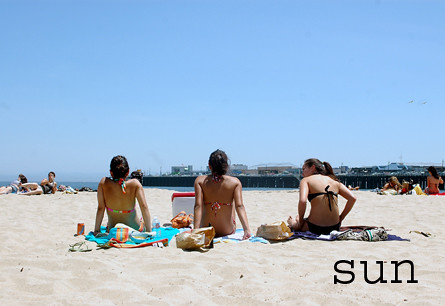
I find it kind of fitting that my last day at the paper ended on the beach... and with a slideshow.
I wanted to try something different and sorta went nuts with the editing. Take a look, it's sorta my parting valentine for the paper. I had some good times there and I'm gonna miss it... hmm.. that sounds like a list full of reminiscing...
  • I'll miss debating the latest news or ethical developments in photojournalism with Shmuel Thaler.
  • I'll miss running into Ryan Sholin everyday and having one of us say "did you see this online..." But seriously brah, you can't let you're daughter's first movie be Transformers, that's child abuse :P
  • I'll remember that first day of looking though the archive and seeing all the cool stuff in there... and then wasting all that time looking at old movie stuff and press packets for TGIF (if I have to explain it, you're to young... and a loser).
  • I'll chuckle when I think of all the office politics and romances that I'm not supposed to know about.
  • I'm miss getting to joke around with Anthony L. Solis in the office and then checking out his photos on Flickr.
  • I'll remember getting lost twice on the way out to an assignment with Soraya Gutierrez and talking about Rage Against The Machine... not to mention rage in general (I still say it was her fault!)
  • I'll wonder how it was that I always (well 99% of the time) ended up driving the reporter to all of our assignments... I'm the out of townee after all.
  • I'll remember the day I got the frantic phone call that the front page story fell through and I'd better do a really really good job (no pressure of course the message said) to help fill the gap "or else."
  • I'll always wonder why it took me three weeks to finally go to a beach.
  • I'll remember the hum of the printing press in the basement as it rumbled to life each night and vibrated the floor in the photo room.
  • I'm not gonna miss waiting for a free computer... or saving all my Photoshoped work to a portable hard drive to move over to the only Mac with soundslides (but no Photoshop) only to discover it's behind a door that was supposed to be unlocked.
  • I'm not gonna miss waiting 15 minutes for Photo Mechanic to start up for that matter either.
  • I never did figure out how to check my work e-mail... I hope there wasn't anything important in there.
  • I'll laugh at all the times I ran out on false alarms for spot news... like going out to a fire and instead finding Frisbee golf (which it turns out is normal) and the time a guy brought dynamite to Costco in his car and went inside to ask "Should I have this?"
  • I won't miss (or understand) having to move my car every hour in Watsonville.
  • I'll remember the day I spent on a story covering bookstores and discover that book stores are pretty cool places.
  • It's a sad fact, but no one actually ever drives the speed limit... unless a cop is around, and even then the cop doesn't drive the speed limit either.
  • I'll sorta regret not going to New York City for spring break.
  • But I'll miss being the point man while two of the three staff shooters were on vacation during spring break.
  • The day I was told that I'm getting too many front pages and doing too good of a job (apparently it's possible).
  • I'll remember when everyone felt I was being taken advantage of with an unpaid internship and they threw a few bucks my way.
  • I'm gonna miss the photo advice from Matt King, less art, more limbs. Got it dude!
  • I'm not gonna miss becoming known as the go to guy for pictures of pets and kids during my first month there. Thankfully that changed.
  • I'll always remember the day I finally got to go to the beach.
  • I won't miss the racist old woman at the bank who asked me where I'm from and wanted to teach me the ways of America. I told her "I can't help it if they let brown people and white people walk on the street together in Canada." (I'm not from Canada.)
  • I won't miss the hippies who believe that listening to George Harrison's post India sitar and doing Yoga somehow makes them spiritually enlightened and somehow as I'm an Indian, that makes me their mystic conduit into the mysteries of the East. Seriously guys, we're just different, stop thinking you're somehow better than others in the West just because you want to be different like us.
  • The day I returned the light kit at school only to need it on the very next assignment. Lesson learned, take out a loan and buy a light kit.
  • I won't miss the time I was blocked in at the fairground with a deadline and couldn't get my car out until way past midnight. (I meet my deadline, don't ask.)
  • I won't forget the garlic fries on the Boardwalk or standing in the framework of the Big Dipper and trying to hold the camera as steady as possible while the roller coaster shook the rails and wooden structure almost violently.
  • I'll remember the letter from a reader who cried after seeing my pictures.
  • I'll miss going down to Watsonville and sharing in all sorts of censored shenanigans... and telling them they were better than the main office and then doing the same when I was back in Santa Cruz.
  • And this will be my last time being a part of the week in pictures.
  • There's so much I'll remember and look back on... but mostly I'll always remember all the cool people I met while on assignment and all the things I learned about them, from them and about myself.
It's been fun, but every chapter has to come to a close.

Labels: , , , , , , , , , , ,

Thursday, May 17, 2007

Asian Representations in American Cinema Developed for a Teenage Audience or Why Doesn’t Anyone Look Like Me?

In another life I spent more than a few years writing film reviews and essays of new and old, classic and infamous, good and bad films for various websites and any press outlets that would have me.

Recently I had the chance to revisit my old passion when it came time to produce a research paper in one of my classes in the Film department at San Jose State University. What follows is that research paper and given this past year of Rossie O'Donnel's incredibly flippant impression to the flame up around Don Imus (why are you hovering over his name? Do you really need a hyperlink?) to just tons of insanity, it's clear to me the topic of my paper is timely to the discussion and I thought it was an interesting enough topic to post here.

Asian Representations in American Cinema Developed for a Teenage Audience
or
Why Doesn’t Anyone Look Like Me?


Teens films came into their own in the 1950s but they’ve only become truly representative of the teenage cultural landscape until fairly recently, arguably making leaps and bounds at an accelerated pace in the last ten years with films like 2000’s “The Debut”, 2002’s “Better Luck Tomorrow” and ultimately culminating in 2004’s “Harold and Kumar go to White Castle,” the stoner comedy that did more to tear down conventional norms and dismantle stereotype then any other film before or since.

In this class we have, over the course of the semester, we have “analyzed how motion pictures have depicted teenage culture throughout history and in a number of cultural contexts,” however we have overlooked one major cultural context as we journeyed through the 1950s to today.

What has been lacking is any portrayal of Asian-American’s on screen. We did have “Crazed Fruit,” a New Wave Japanese film that looked at adolescence and coming of age, but it looked at growing up in Japan from a Japanese perspective and had little to do with American culture or the Asian teenager growing up in America.

For the most part, Asian characters have been caricatures of the real thing in films such as the Charlie Chan franchise, in subservient roles such as in films like “Short Circuit” or shows like “Happy Days,” diluted icons to be oversimplified and made digestible for a mainstream white audience such as in the film “The Karate Kid” or on the show “Kung Fu,” or they are walking stereotypes obsessed with sex, western culture and mathematics on shows like “Seinfeld” and films like “Sixteen Candles.”

As a whole, fully realized and developed representations of Asian-American teens, even Asian-Americans in general for that matter (how many times have we heard Jackie Chan complain of the offers he gets for roles or for that matter how many Asian-American’s do we see on screen that are not women on white men’s arms?), have not existed in the mainstream.

In what follows I will examine the portrayal of Asian-American’s in cinema and chart the progression of the portrayal of this culture in the larger subculture of teen films as defined in the class using 2000’s “The Debut”, 2002’s “Better Luck Tomorrow” and 2004’s “Harold and Kumar go to White Castle,” as examples to illustrate my point.

Just as the world was ringing in the new millennium a little film from a collaboration of ethnic filmmakers was setting out to promote and release their film, appropriately titled “The Debut.”

The story was a fairly simple telling of a pair of Pilipino-American teenagers coming of age in San Francisco and focused on one night in the life of high school student Ben Mercado (Dante Basco, of “Hook” fame).

Ben like many Asian-American’s was trying to assimilate in the MTV dictated culture that surrounds him and would rather play basketball, listen to hip-hop, go out with his friends and avoid at all costs his family’s traditional ways and cooking. So when his sister’s traditional coming of age Debut party comes around, it becomes one night of discovery and cultural battles that force Ben to examine who he is.

Pretty much a by the books story arc of alienation and coming to terms with who you are when growing up, but it was monumental for the progression of Asian-American’s on scene by showing that there are issues that Asian-American’s deal with that are just as important as the issues that Tom Cruise, Kid n’ Play and John Travolta dealt with in other mainstream films.

This film opened the door to the idea that Asian-American teens also deal with the same alienation and coming of age that white teenagers do and as it became the first Pilipino-American film it also proved through its grassroots campaign that there was an audience for teen films that included Asian-American’s in the discussion.

It was a small but important step in opening the door and open the door it did, because two years later newly established MTV Films was looking to sign their first film as a production house and distributor and selected Justin Lin’s “Better Luck Tomorrow” to lunch their label.

It was a bold move on the part of MTV Films and many questioned if they were making the right move, most famously the story goes that after its premier at Sundance, and just before MTV Films picked it up, many in the audience lambasted the director and producers for portraying Asian-Americans on the screen in such a light. Some wondered why they had to be shown in such harsh light and others questioned if it was ethical and even moral to show them in negative ways that were less than ideal and accused the director of being irresponsible to his culture.

One wonders if these same outspoken detractors would lay the same claims at the feet of similar films staring white teenagers, such as in “American History X,” or black teenagers, for example “Menace II Society”

As I’ve only hinted at thus far, the plot did cast Asian-American’s in a brutal light, by turning the accepted ideal of the Asian-American overachiever with a laser-like fix on college entrance exams and quadratic equations into a criminally fascinated and sometimes violent teenager on the verge of entering adulthood and fighting to define it on there terms.

The film harkened back to the violent Caucasian teenagers of rebellious 1950s teenage films like “Rebel without a Cause” and recast the players and moved beyond the stereotype to ask: Aren’t Asian-American’s just like everybody else? Why should Asian-American’s on film be any different? And isn’t this just as valid as any other teleplay of white or black teenagers?

“Harold and Kumar” built on the progress that “Better Luck Tomorrow” had made in turning the Asian-American stereotype on its head two years after that film had come and gone from theaters and the cinema’s collective debates. The film even managed to work in a reference to the previous film, when a bully taunts Harold (John Cho, who also stared in “Better Luck Tomorrow”) by referencing the title of that film.

Right from its first scene it is established that this is not going to be your average teen film with the introduction of white males that exit the film like any other comedy of this flavor, but then the camera doesn’t follow them, it stay on Harold. And it becomes a teen movie that for the studio will make money, but for the community will make stride, and while the characters may be two 20-something roommates on the road track to careers and midlife crisis, the audience is clearly the teenager.

It’s surprising to learn that it took two white men to helm the project and stick to their guns against studio pressure for ethnic casting for the leads, but regardless of that, “Harold and Kumar” was loaded with clever jabs at stereotypes, for instance just before the end credits, caricatures of a man in a turban and another in a traditional straw hat are shown on a wanted poster. In another scene the film “Sixteen Candles” is discussed, which has a very stereotypical portrayal of Asians and is cleverly contrasted, for those familiar with the film, to the Asian face we see in this film nearly 20 years later.

At another point, Kumar goes into a speech about the American dream and how it is their right and duty to get the food they seek and devour it in the name of every ancestor and minority that has struggled to be equal with the accepted mainstream majority. Harold and Kumar’s strife and desires are no less worthy of a film than the white men that peeled out of the lobby in the opening credits.

This attacks societies accepted norms of different people and causes an audience who has just spent nearly two hours with these characters to reflect and rethink their notions of what they think of Asian-Americans.

In many scenes the image of the studious Asian-American is turned upside down with wild parties and rambunctious exploits and in others the manly dominate white males are recast as weak effeminate men that puff their chest at any threat to their dominance.

At the time the film became a box office boon for the studio, but in hindsight, “Harold and Kumar” is more than another stoner film, like Cheech and Chong before them, Harold and Kumar challenged societies accepted norms and through means of easily digestible and packaged delivery got in people’s faces about what they believe and the stereotypes they carry with them about Asian-American’s.

These films collectively have gone a long way in putting Asian-American’s on the screen and giving these teenagers a familiar face and teen movies in general a more accurate representation of the current American landscape.

Today it is becoming more common to see Asian characters in films, if only in minor roles at the moment, but at least we are speaking now next to the white leads instead of just serving them lunch or waiting to fix their girlfriend’s computer before the big dance.

There is still a long way to go. As I have shown here, the truly milestone films have only shown up once every two years and since 2004 there have been no major Asian-American’s on TV or Film. Hopefully that will change as the idea of Asian-American’s in media become more of the norm than exception among studio project proposals and as young Asian-American teenagers of today go on to become the adult Asian-American consumers of tomorrow.

Labels: , , , , ,