Today the last issue of the Rocky came off the presses and as the ink dried on the page, the last truck left the facilities and the newsroom doors close, it marks the end of another great photo paper.
For one there aren't many places hiring, but bigger than that, the Sun is one of the few papers that "get's it" in terms of multimedia. And currently, IMHO, it's one of the quickest growing papers. Remember Roanoke about five years ago? That's the Sun today.
Just look at all those multimedia positions just ripe for the taking. I personally know at least a dozen of you out there that would be perfect for this.
Still waiting for Photosynth 1.0 and now they're dangling 2.0 as well
I wrote about Photosynth last year, with great excitement and at great length I might add (with too much length and excitement some of you might add) and after all this waiting and not seeing anything come out of it, I'm now getting all excited for the next evolution of this software.
The idea of a individual documentation being universally chained and bound to create a richer, deeper and more informative tapestry is exciting. And the new transition structure and ability to navigate "key frames" (my term, not theirs) around public images opens up whole new methods for structure and navigation. Plus now you don't just point at stuff and zoom around, now you actually walk though it in near real-time.
(Awesome!)
Check it out in the video below (I'd say more, but I really can't add to anything I didn't say last year.)
If that video wasn't enough for you, check out the SIGGRAPH 2008conference paper the team submitted for all the jargon filled goodness.
Oh MS, I have a sneaking suspicion you're just using this as tech demos that will be implemented in other products (MS Live Maps anyone? Google Maps street view killer perhaps?)-- why do I let you rile me all up and get excited? Why?!
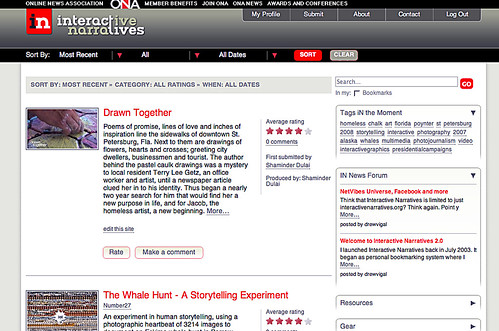
It's back and thank goodness! After the fall of MultimediaShooter I was itching for a place to see multimedia on a consistent basis.
Five years ago, IN founder Andrew DeVigal was snatched up by the New York Times and the web site slowly stopped seeing updates. But now its back and it's taken on a social media twist.
Now any registered user can post multimedia and share what they find directly m with the masses.
I experimented with trying the same thing on Ning, but it failed to take hold, and for a while was playing with Pligg, a digg clone, but I could not have come near anything like this on my own. The social media aspect adds whole new dimensions and will hopefully ensure that it doesn't go away again.
You see that man in the picture to the left. That's officer D. Guzman. He is an asshole. The kind of cop that gives good cops a bad name.
Read the story and check out the video. And then try not being outraged like I am right now.
This is outlandish and should not be tolerated. I urge you all to contact APD to complain, contact their leadership directly and contact your regional and national NPPA leadership to urge them to file a formal complaint with APD.
This is bulls*th!
While in ABQ I dealt with the cops here on many occasions and I wish I could say this was a rare mistake, but it was more like something inevitable. Out of every city I've worked in: San Jose, Oakland, San Fransisco, Santa Cruz, Hollister, Los Angles, Houston, DC, New York, Miami, Orlando and many others... I can say without a doubt that the APD beat cops are the worst. Rude, self-righteous, arrogant and looking for any excuse to cuss you out, arrest you or in this case beat you.
I don't want to say every officer I've encountered has been this way (I can remember two that were pleasant and professional) but from my experience, 98% of them were bullies with a badge.
The issue I think isn't with the leadership within APD or with training, the issue is that like many police forces around the country, ABQ is facing a shortage of officers. Adding to the pressure is a voter mandated quota to have a certain amount of new officers on the streets each year. This had lead to the department, IMHO, hiring anybody with a pulse that's willing to do the job. The result is a lower quality of officer and well, you saw the video.
Old friend and SJSU alum Ivan Kashinsky recently had a story published on Time magazine's Web site. Ivan documented Pablo Fajardo, a lawyer who represents 30,000 Ecuadorians in a lawsuit against the oil giant Chevron.
The lawsuit alleges that Texaco, acquired by Chevron in 2001, left behind oil waste pits during the eighteen years in which it drilled in the region and that this has contributed to a higher rate of cancer and other ailments among the settlers and indigenous people who live there.
Take a look! I thought it was worth mentioning, besides his work always inspired me so why not share it.
Dear friends, family, colleges, mentors, random SLR readers, exs past, present and future, hangers-ons and one Yorkshire named Bentley… I’ve got some big (ahem BIG!) news to share.
Either someone is playing an elaborate prank on me, or I just became the newest Hearst Fellowship Recipient.
I just got the call on Sunday from Kenn Altine, the Hearst recruiter who encouraged me to submit an application last fall, informing me I am one of the four selected for this year.
I was literally speechless.
I think I managed to say, “are you kidding?” before I just went silent, unable to find any more words.
Is this my big break? It sure feels like it. I’m still not sure what to make of it all.
Over the last couple days I’ve spent a lot of time thinking about how I got into photojournalism in the first place, mostly because I kept getting asked that during the interviews. And now again, in the wake of this news, I’m thinking a lot about how random life can be.
I would not be a Hearst fellow if I hadn’t meet Kenn last summer as an AAJA Voices student project staffer. He would never have sent me an application if I had decided to head up to my room for a nap after my hectic week with no sleep, instead of downstairs to the job fair where I was only able to catch the last half hour of it.
I would not have chosen to make him one of the four recruiters I had spoken to, had I not had been a subscriber of The San Francisco Chronicle. We probably wouldn’t have had such a pleasant conversation if I hadn’t known that paper or the people that worked there so well or the stories of those people.
I would never have been at the AAJA summer convention if I hadn’t been accepted into the student projects and I never would have applied for the project had I not met Joyce Lin at the AEJMC convention the prior year, where she told me all about the summer ‘06 convention she’d just come back from.
And I never would have been at the AEJMC convention had I not been recommended for it by then current photojournalism instructor Thomas Rodgers, who would not have thought of me had I not earned his endorsement when I was photo editor and he was our adviser on the Spartan Daily.
And I would never have taken on the task of photo editor had the prior photojournalism instructor, my college PJ teacher, Dennis Dunleavly, not encouraged me to.
And… I can keep going further and further back… but my point is, as I think about these things now, it’s funny how one little choice can have a ripple effect on everything else you ever do.
What if… so many what ifs.
And today again, as I take down this new path, I’m thinking a lot about the coulda, shoulda, woulda and what ifs. I think that’s why I loved watching the “Back to the Future” movies so much as a kid (the seemed to always be on NBC in the late 80s and early 90s), the idea of how one thing can change everything fascinated me then and continues to today.
Life is an adventure, you only go around once, live for today. Life's always been more interesting without a road map.
Another one from the file "I haven't mentioned it because it felt like bragging," a few months ago I got a call informing me I was a finalist for the Hearst Fellowship. There are 12 of us now and they'll soon narrow us down to the final four selected (which kinda sucks! I've meet some really down-to-earth and smart people). They also tell me I'm the only photographer to make the finals and one of the few ever in the history of the program.
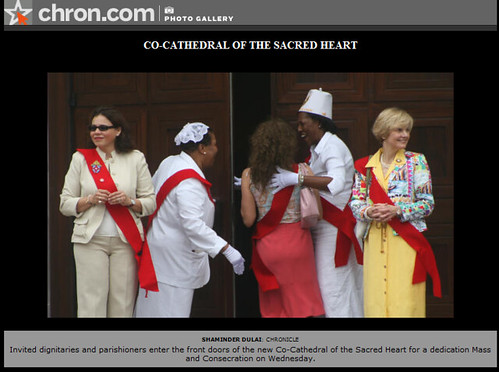
On Tuesday I was flown out to Houston for interviews at the Houston Chronicle. Today was the first day of the two-day process and part of my morning consisted of going out to shoot an assignment and produce at least two features and a short video for the web.
I ended up shooting the dedication of the new Co-Cathedral of the Sacred Heart, which proved to be very... "interesting" (more about that at a later date).
Click on the above screen shoot of one of my three pictures that was featured in the story story slideshow (Smiley, the photog assigned to it is an awesome shooter- with an awesome name!- check him out) and also in the Editor's Pics slideshow (Steve Gonzales is a pretty nice guy).
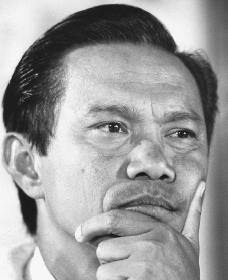
Dith Pran, the Cambodian-born journalist whose harrowing tale of enslavement and eventual escape from that country's murderous Khmer Rouge revolutionaries in 1979 became the subject of the award-winning film "The Killing Fields," died Sunday. He was 65.
Dith died at a New Jersey hospital Sunday morning of pancreatic cancer, according to Sydney Schanberg, his former colleague at The New York Times. Dith had been diagnosed almost three months ago.
Dith was working as an interpreter and assistant for Schanberg in Phnom Penh, the Cambodian capital, when the Vietnam War reached its chaotic end in April 1975 and both countries were taken over by Communist forces.
Schanberg helped Dith's family get out but was forced to leave his friend behind after the capital fell; they were not reunited until Dith escaped four and a half years later. Eventually, Dith resettled in the United States and went to work as a photographer for the Times.
It was Dith himself who coined the term "killing fields" for the horrifying clusters of corpses and skeletal remains of victims he encountered on his desperate journey to freedom.
The regime of Pol Pot, bent on turning Cambodia back into a strictly agrarian society, and his Communist zealots were blamed for the deaths of nearly 2 million of Cambodia's 7 million people.
"That was the phrase he used from the very first day, during our wondrous reunion in the refugee camp," Schanberg said later.
With thousands being executed simply for manifesting signs of intellect or Western influence, even wearing glasses or wristwatches, Dith survived by masquerading as an uneducated peasant, toiling in the fields and subsisting on as little as a mouthful of rice a day, and whatever small animals he could catch.
After Dith moved to the U.S., he became a goodwill ambassador for the United Nations High Commissioner for Refugees and founded the Dith Pran Holocaust Awareness Project, dedicated to educating people on the history of the Khmer Rouge regime.
Schanberg described Dith's ordeal and salvation in a 1980 magazine article titled "The Death and Life of Dith Pran." Schanberg's reporting from Phnom Penh had earned him a Pulitzer Prize in 1976.
Later a book, the magazine article became the basis for "The Killing Fields," the highly successful 1984 British film starring Sam Waterston as the Times correspondent and Haing S. Ngor, another Cambodian escapee from the Khmer Rouge, as Dith Pran.
The film won three Oscars, including the best supporting actor award to Ngor.
"Pran was a true reporter, a fighter for the truth and for his people," Schanberg said. "When cancer struck, he fought for his life again. And he did it with the same Buddhist calm and courage and positive spirit that made my brother so special."
Dith spoke of his illness in a March interview with The Star-Ledger of Newark, N.J., saying he was determined to fight against the odds and urging others to get tested for cancer.
"I want to save lives, including my own, but Cambodians believe we just rent this body," he said. "It is just a house for the spirit, and if the house is full of termites, it is time to leave."
Dith Pran was born Sept. 27, 1942 at Siem Reap, site of the famed 12th century ruins of Angkor Wat. Educated in French and English, he worked as an interpreter for U.S. officials in Phnom Penh. As with many Asians, the family name, Dith, came first, but he was known by his given name, Pran.
After Cambodia's leader, Prince Norodom Sihanouk, broke off relations with the United States in 1965, Dith worked at other jobs. When Sihanouk was deposed in a 1970 coup and Cambodian troops went to war with the Khmer Rouge, Dith returned to Phnom Penh and worked as an interpreter for Times reporters.
In 1972, he and Schanberg, then newly arrived, were the first journalists to discover the devastation of a U.S. bombing attack on Neak Leung, a vital river crossing on the highway linking Phnom Penh with eastern Cambodia.
Dith recalled in a 2003 article for the Times what it was like to watch U.S. planes attacking enemy targets. "If you didn't think about the danger, it looked like a performance," he said. "It was beautiful, like fireworks. War is beautiful if you don't get killed. But because you know it's going to kill, it's no longer beautiful." After Vietnamese forces invaded Cambodia in 1979 and seized control of territory, Dith escaped from a commune near Siem Reap and trekked 40 miles, dodging both Vietnamese and Khmer Rouge forces, to reach a border refugee camp in Thailand.
From the Thai camp he sent a message to Schanberg, who rushed from the United States for an emotional reunion with the trusted friend he felt he had abandoned four years earlier.
"I had searched for four years for any scrap of information about Pran," Schanberg said. "I was losing hope. His emergence in October 1979 felt like an actual miracle for me. It restored my life."
After Dith moved to the U.S., the Times hired him and put him in the photo department as a trainee. The veteran staffers "took him under their wing and taught him how to survive on the streets of New York as a photographer, how to see things," said Times photographer Marilynn K. Yee.
Yee recalled an incident early in Dith's new career as a photojournalist when, after working the 4 p.m. to midnight shift, he was robbed at gunpoint of all his camera equipment at the back door of his apartment.
"He survived everything in Cambodia and he survived that too," she said, adding, "He never had to work the night shift again."
Dith spoke and wrote often about his wartime experience and remained an outspoken critic of the Khmer Rouge regime.
When Pol Pot died in 1998, Dith said he was saddened that the dictator was never held accountable for the genocide. "The Jewish people's search for justice did not end with the death of Hitler and the Cambodian people's search for justice doesn't end with Pol Pot," he said.
Dith's survivors include his companion, Bette Parslow; his former wife, Meoun Ser Dith; a sister, Samproeuth Dith Nop; sons Titony, Titonath and Titonel; daughter Hemkarey Dith Tan; six grandchildren including a boy named Sydney; and two step-grandchildren.
Dith's three brothers were killed by the Khmer Rouge.
I never had the opportunity to meet him, the closest I ever came was winning second place last summer in the AAJA sponsored Dith Pran photo shootout.
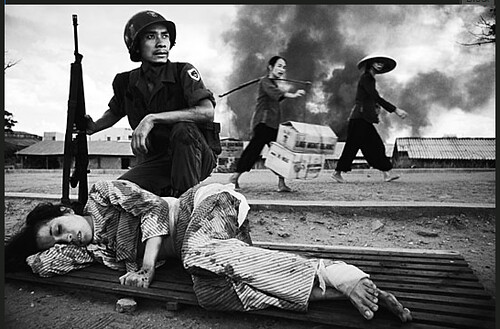
Philip Jones Griffiths passed away yesterday (or early this morning, details are still sketchy), you might remember him from his work in Vietnam and the subsequent book "Vietnam Inc." which lead Noam Chomsky to comment on it that: "If anybody in Washington had read that book, we wouldn't have had these wars in Iraq or Afghanistan."
And after that, be sure to take a look at his Vietnam work featured in WARS. In a coincidence Magnum just published a new series on war and his is one of the first four featured. It's an amazing piece, not just for the pictures, but because we get to see and hear Griffiths talk about the experience in his own words. Not to be missed, and what a way to honor a fallen master.
After giving us all a huge scare last week when MultimediaShooter.com was hacked, and according to Richard they messed it up so bad that he wasn't planning on jumping back on in a hurry. (I know I couldn't log in to the user panel at all, so it musta been something major.)
"RIP... I do not have the time or resources at this time to continue. I wish you all the best."
A little dramatic, but you can't blame him, that was his baby. Plus with all else that's on his plate, being an ambassador in the Merc newsroom, having to work in the lay-off ridden Bay Area and of course he's so in demand (it's nuts).
But all that doesn't matter now. Thanks to a community that poured out in support and offered aid, Richard decided there was no way he was ready to lay it to rest and now MultiMediaShooter is back! (Which is good, b/c there are some real goodies in store... let's just say, the site is entering a new era.)
Best of all, he took this disaster and turned it into an opportunity to create another short film (and his first foray into Vimeo)... correction, another AWESOME short film, with nice pants!
Ran into a big hunk of equipment complications today, basically I need a portable power pack, and so in my research I ended up heading over to see what ol' man David Hobby, aka the Strobist guy, was up to these days.
I see he's posted this video for Canadian rock group "Aquaplane" which was composed entirely out of still photographs.
The video, IMHO, is a utter failure, or as you l33t speakers say: an epic fail (seriously, when did that become a popular saying?!). It's not for the photos or the production value, it's because the style of the video does not match the band or the song. That old wisdom, it can look cool, but if it doesn't tell the story it ain't worth $#!t holds true here.
Nevertheless, this does give me an opportunity to start thinking about new tools for multimedia and how we can tell our stories with different techniques.
The process they are employing here is an old one. Basically a sense of depth and movement is created by placing different visual elements on different planes and then moving a camera in zooms and pans about the scene to give it that "inside the image" illusion.
Walt Disney first employed it in Bambi, by animating multiple glass plates with different layers of the forest and then sliding them in and out as the camera tracked in on the action. The result was very much the same and it never really moved beyond animation or Magic Eye toys until Adobe created After Effects and some animators and photo guys got curious. (In the simplest of terms you're cutting out each element and then placing it on a different layer that you can then slide around at various speeds in front of a camera.)
Recently I've seen the famous 1976 do this to great effect (1976 is also why I know so much about how it's done since I was obsessed with reverse-engineering it) and also the opening credits of the TV show "How I meet your mother" uses it as well.
In the last couple months I've seen lots of new developments in multimedia tools: Vumox, Animoto, PhotoSynth (still looks promising) and the video flash players keep evolving (the new BlipTV looks nothing like the old one)... and now that many of us have gotten past the hurdle of just learning how to do it, we can start thinking about how we present it.
Maybe After Effects is the next program to learn...
I may not be at San Jose State University anymore, but last week one of our projects during my time finally moved from a great idea to the real deal.
The SJSU Multimedia Academy was brainstormed last spring as a multi-year, world-wide program to explore the stories that litter the planet, just waiting to be found.
And if that's not enough, we (somehow) got The San Jose Mercury News and National Geographic on board as co-sponsors and then got them to commit one staffer as a faculty member on each trip.
Like those ping-pong tables we raised money for in the 8th grade, I won't be around to enjoy the fruits of our labors, but trust me, if you have the cash as the desire, apply!
Here's the official word:
Students are invited to the SJSU Multimedia Academy. Jim Gensheimer from the Mercury News will co-teach in South Africa and Sadie Quarrier, Sr. Photo Editor, at National Geographic Magazine, will co-teach the program in Ghana from June 16 to July 4, 2008.
www.sjsu.edu/studyabroad
Students can earn three units of credit. The cost is $4,200. SJSU Special Session Tuition (3 Credits @250/unit) $750 SJSU Program Management Fee $200 Program Fee $3,250
The registration deadline is March 3. The monies are due at a later date.
MCOM 180: SJSU’s Multimedia Academy • Co-instructed by National Geographic Photojournalist • Explore Real World multimedia journalism • Produce compelling multimedia stories in the field and on deadline • Learn the importance of discipline with time, shooting, and gathering information necessary to advance the story • Learn the importance of research, organization, adjusting, adapting and patience • Earn 3 units of SJSU credit
This program is open to all undergraduate and graduate students who are matriculated towards a degree at a U.S. university or college. Students who have successfully completed their advance photojournalism and or broadcast sequence courses are especially welcome to take this course.
Proudly co-sponsored by National Geographic Magazine and the San Jose Mercury News, the SJSU Multimedia Academy is an ambitious, three-year program designed to give photojournalism students and broadcast journalism students the opportunity to gain an edge in the competitive job market. The San Jose Mercury News has committed one staff photographer or multimedia editor to co-teach the three-week course in South Africa.
Besides Ghana and South Africa, the multimedia academy will explore Brazil, India, Bangladesh, The Philippines, Vietnam, Japan, South Korea, China and Dubai. Each program location will have a National Geographic or San Jose Mercury News staff photographer or multimedia editor to co-teach the program. At the conclusion of the program, a coffee table book exhibiting the students’ work will be published, along with a behind-the-scenes DVD documentary. A photography and interactive multimedia exhibition featuring the students’ work will also travel the U.S.
The fee includes tuition, air fare (West Coast departure) and hotel accommodations. These estimated coasts do not include personal expenses as this varies among different participants.must take the following MCom 180 (INDIVIDUAL STUDIES) 3-unit course. http://jmcweb.sjsu.edu/courses.html
Prof. Michael Cheers, who coordinates the photojournalism sequence at SJSU, will lead this program. Cheers, the 2007 Faculty Fellow at National Geographic Magazine, worked more than 20 years as a photojournalist in Africa. Jim Gensheimer, an award-winning staff photojournalist for the San Jose Mercury News, will co-teach this course.
More info, D. Michael Cheers,Ph.D Director of Photojournalism San Jose State University mcheers@casa.sjsu.edu 408-795-5062 or 408-924-3259
Study Abroad Office: International Programs & Services San José State University Located in Clark Hall, Room 543 One Washington Square study.abroad@sjsu.edu San Jose, CA 95192 408.924.5931 408.924.5976 Fax
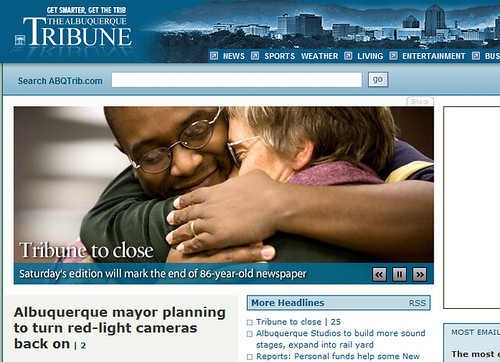
I've talked about it before, joked about it and held out hope from the inevitable... but today it has come.
This morning the staff of the Albuquerque Tribune heard the news, Saturday would be their last day and after 86-years the doors will closed one last time.
It wasn't the paper of my internship, but I'd grown to love the Tribune over my time here, even gotten to know many among the photo staff to the point I'd consider them friends.
The first time I'd walked over to say hello wasn't until late Dec. Their photo editor, Mark Holm, was sitting at a desk working an end of the year homicide infograpahic. When I said hello, he just looked up and said, "It's about time you made it over here."
That's how everyone over there was, always inviting, always willing to stop and have a chat. Always willing.
Erin Fredrichs invited me as her guest to a party for the same night that I'd met her for the first time, while we were shooting the same high school football game.
Steven St. John was the quite guy who was always focused during an assignment but willing to talk about anything in between the cracks. His was also the first photo column I saw, the weekly page 2 feature of the Trib that become a part of my Monday ritual at work.
Craig Fritz was shooting the crash site from my left and talked to me at the scene of a fatal balloon fiesta accident about how he's had to deal with death and balancing the job with everything else.
I finally met Michael Gallegos last week after spending nearly the entire six months hoping to run into him at the office. He'd graduated from San Jose State University many (many) years before me and had e-mailed me out of the blue to say hello. Finally we did meet, and it turned out to be a really great conversation. He'd extended me an offer to tag along on photo shoots if I was interested, that sounded like a great time out.
It's funny how the paper and I were both on the same tracks, announcing their plans for a sale within weeks of my arrival and now closing up shop about a week after I had done the same.
My roommates girlfriend worked there and let me know right away which side I had to be rooting for. During my first full week of work, she'd decided to take a dry erase marker to my car and had tagged my windshield and driver side window with the phrase, "Viva la Tribune!"
It's still there today, maybe I couldn't do it, wash it off. Or maybe I just never got around to wash the car in the last six months, whatever the reason, looking at that window now... yeah...
It's like we both knew an end was coming and were trying to do our best work, because who knew when we'd get to again.
I'll never forget all the times I've looked at their front pages and said, "Wow!" or "I wish I'd seen that," or more often than not, "How'd they get away with that?!"
For the short time I was able to read it, I was inspired, but I guess all good things must come to an end.
Now if you'll excuse me, I have to watch, read and experience all the multimedia, photo columns and slideshows one last time before the website is taken down and another storied chapter comes to a close.
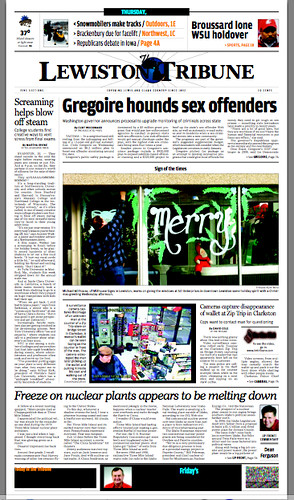
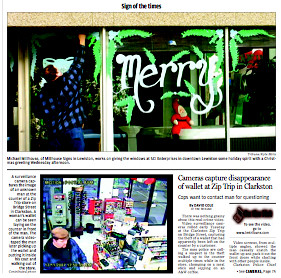
The best layout in the history of newspapers (take a long hard look)
Do you see it?
No? Focus on the center. Take a look at the two pictures, and no they aren't from the same story.
It maybe hard to read here, but the top image is a stand alone feature and the one below it is a news story on a stolen wallet, the surveillance camera that caught it on tape and pictured the suspect whose identity is unknown.
So here's a thought. When we were just starting out in multimedia a short 2 (3?) years ago, we were all giddy and excited and couldn't wait to play with our new toys. And very quickly we started experimenting and trying new things and after a short gestation period with the basics many of us started thinking about how we edit in four dimensions rather than just two, or three when it came to layout. All of a sudden we had Time to deal with, and that made everything a lot more interesting.
So we started doing fancy stuff like tiles, fades, cross-fades, pans, and then we got even fancier with split screens and flipbooks (or if you prefer a more avant guard, montages), but what since then?
It's like we're running out of tricks. Maybe it's just me, but I haven't seen anything new. When I started playing around I used all the basic film editing tricks I had picked up, and by the time everyone else was doing the basics I moved on to experiment with flipbooks, and when others started doing that, I had already started experimenting with split screens and selective crop-ins and other goodies.
I felt that each time I had managed to stay ahead of the curve and was trying something new, but now I'm just not seeing it. I'm still doing flipbooks and split screens and pans and whatnot, but now so is everyone else. It's like we've all run out of new tricks.
We're all doing the same thing, I mean EVERYONE is flipbooking today! And it's starting to get stale and homogenized.
I think that may be because we're still looking to film for our guide map. Perhaps it's time we stop looking to mimic everything that's come before and start creating.
We need some new tricks.
*Thinking out loud is where Shaminder just blabs about whatever pressing thought is on his mind.... so in other words it's just like Twitter, but he refuses to remember another pair of passwords and log into another program everyday. He also refuses to say 10-4 on the Nextel, but that's another story.
The annual contest marking the best work coming out of college photographers announced their picks for 2008.
A lot of familiar names on there and a few really gripping images to.
Although some of the images left me scratching my head, I won't name names but how it is in one breath we denounce overdoing toning in photoshop (Patrick Schneider) and than at the same time applaud those who have obviously done the same with contrast ratios and levels?
And in some of the stories I can't see a narrative thread. Yes all the pictures are extraordinary and I'm better for seeing them, but where is the storytelling?
This is a touchy subject, and I'm trying to be very careful in what I say as not to appear bitter or elitist. Well, first I didn't enter so I can't be bitter and I'm a nobody so I have no reason to be an elitist. (So that's settled.)
All the folks that won are obviously talented and I'm very glad I clicked on the pictures, don't get it twisted, I'm just thinking out loud here.
On another note, it's nice to see some of the multimedia work coming out of schools these days. There is so much cool, moody, thoughtful, informative, intimate and at times inspiring work to check out. I haven't even got through it all yet (there's so much!) but I can see there are some really nice projects there.
I don't write about technology often, I know, this coming from the guy that posts about video-hosting websites, new cameras, RAW processing and Microsoft's table computer thing, but honest I don't do it often, check!
Anywho I was looking at the Natchway speech from the TED awards again, and I saw this other video on the site for a software application called Photosynth, which presents us with a new way of organizing, manipulating and viewing digital images.
(They were recently acquired by Microsoft as well... It looks like Microsoft is positioning itself as a major player in digital imaging?)
Pretty amazing right?
I think it's cool to think about organizing and being able to move stuff around and arrange your files in a GUI that's both slick and fast, not to mention the amazingly innovative and revolutionary idea of, as its creator Blaise Aguera y Arcas calls it "creating hyperlinks between images" based on the content of those pictures. Which is like the Google Maps new local pictures tab (which got into some trouble) but ten times cooler!
Still not getting it?
Imagine all the pictures on Flickr of the Golden Gate bridge being combined to create a mosic of images rendered into a 3-D space that you as the user are free to move around, zoom in and out off, click on any point to see a real picture of that point, from that point and from virtually every angle allowing for you to generally direct your own unique navigational experience though the collection.
This is revolutionary and can change the way we store and call up information.
It creates a "collective memory" of the real world space and archives it for anyone looking to see it.
Think of it as a visual wiki (btw, if that term catches on, I coined it!)
I've seen some baby steps made into this area in journalism with data based multimedia, most notably Andrew DeVigal is steering some really intertesting experiments in this area at the New York Times, but after seeing Photosynth in action, it only hints at the potential and challenges us to go much further.
What I find really interesting
Now this is all new and as you can see, quite fascinating (for me) and "from the world of tomorrow!", but what I find to be really the most interesting thing is what's found at 1:42 of the video.
The video goes on to show how this technology is so developed for image processing and delivery, that it can not only store entire novels, but also newspapers; that can be zoomed in and out of and navigated from pages within a section or other sections all together within seconds. (Look just watch the video, I'm never going to do it justice by trying to describe it.)
My pal Ryan's been talking about e-Paper for a while and how it's going to replace printed newspapers, well, as much as I'll miss the smell of ink (maybe they can sell it in a mist?) and tearing out interesting articles, pictures, comics and ads that I'll want to place in my sketchbook or research more about (maybe e-Paper can come with del.icio.us.) I can't deny it.
E-paper is coming, assuming RSS and online delivery doesn't replace it as wi-fi comes to cell phones and everything from a PSP to TiVo to refrigerators with built-in screens (I've still got one on reserve Hanna ;) are starting to connect to the web and offer information everywhere anytime whenever.
I can see e-paper and something like photosynth combining and giving us the next newspaper, or newspaper 2.0 or whatever the techie marketers will call it.
What I find really-really interesting
Ok, that's what I find to be really fascinating, but what I find to be really-really fascinating is the new forms of multimedia we can produce with this technology on newspapers.
Yes folks, this is the most important part and the ideas that I think are relevent to our industry and to me as a photographer and new-media thinker.
Say we're sent out to cover another protest story (yes, another one) and we're looking for a new angle (just to challenge ourselves if nothing else) and of course if you're anything like me, you're thinking multimedia. So why not cover the protest and get all the killer pictures you always do (you're so good) and of course we'll get the ambient sounds and interviews (of course) but what about the presentation?
Many of us just throw it in soundslides or edit a video in Final Cut, Premier Pro or iMovie, but we never really think about presentation or what sort of interface the viewer will use to engage with our work.
Some of this can be caulked up to time constraints and impeding deadlines (I know every time I've done multimedia it's always been on my own time) but a larger reason is that everyone already at a paper is so busy trying to learn the new programs and tools used to make these new things that no one is thinking about how to show them off... because Flash is hard and many papers don't have multimedia editors (yet) to budget for these things.
So I'm looking at Photosynth and I'm thinking of that protest story and I'm getting excited thinking about all the possibilities.
Like rendering the photos into a 3-D environment and interviews could be mapped to the subjects with a picture of them where they were in the 3-D space when you spoke to them and then map the ambient sounds to their sources within the environment. Birds chirping in the tree, the plane flying over at the end of the street, the ding-dong of the cross walk sign, the wheels of the skateboard from that kid on the sidewalk...
This could allow letting people navigate their own way through the story and find interviews and story blocks and pictures in completely unique and innovative ways.
Copy from a story could show up in newspaper boxes, posters on walls could link to related stories, zooming out to a birds eye view could turn the scene into info graphics or other data-based multimedia).
And we can then take it one step further by inviting the public to submit their pictures from the event to further develop the archive of the collective memory.
How cool is that?
I know some folks on photo staffs will hear things like this and fear it, but I say embrace it. Embrace it before the kid fresh out of college (me) embraces it and comes into your newsroom.
Welcome back to Time out Tuesdays, a continuing effort to share the stories that resonate with me and to keep myself constantly spelunking for the very best in photojournalism week after week, I've decided to start this new feature.
Every week, I'll post up a new photo story, video, picture or multimedia piece that I think gets it right and is worth taking a look at for study, ideas, appreciation and inspiration.
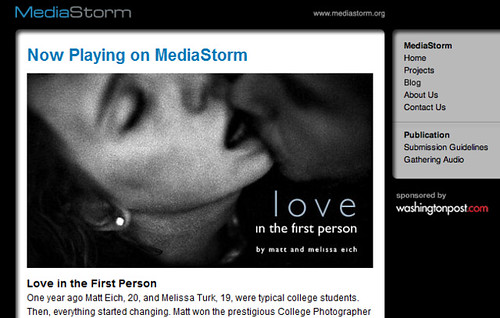
Matt Eich showed us a piece of this back in Portland during the NPPA Immersion Workshop weekend and I'm now pleased to be able to share it with those that weren't able to attend.
It's a subtle presentation that doesn't quite fit the conventional norm, but as a personal journal that employs the tricks of long form documentary film making it works.
It is very much in the vein of the New York Times wedding-how-we-met series, but whereas those feel like feature-y profile pieces, this goes more in-depth and digs to create the intimacy and personal connections that all shooters with documentary aspersions hope to have.
Watching this, you feel as if you're a part of their journey.
I won't call it brave (that word has lost all meaning anyway), we're photographers, this is what we do, but rarely does anyone do it this well.
Now granted the main photographers are the subjects so of course the intimacy is there, but that doesn't mean the same can't be done with an unfamiliar subject. Afterall isn't that the point? As my old PJ instructor Dennis Dunleavy used to say: intensity, immediacy and intimacy. This one has it in spades and despite first appearances it's not as easy as it looks.
Speaking of looks, let's not forget the sound. It's not often I find a piece that exemplifies the crucial necessity of audio to a piece's success.
Listen to this one again with the sound off and you'll notice it isn't nearly as effective. The low ambient score with the touches of sound effects from tapes being rewinded or camera clicking at the wedding add a lot to the immersion and draw you in to the story further. Plus sounds have an emotion quality. Every click, beep, footstep and pause carries with it storytelling.
Than again, you can pretty much look to any presentation from MediaStorm for excellent attention paid to the ears. That's just one of the perks of realizing the production house model can and will work and hiring the right people. (Seriously, why is no one else picking up on Brian's model? It's not hard folks, it's just the Hollywood system. If I had the capital I know I'd be doing it.)
Matt's personal story may not seem like the most obvious choice, but I'm looking to it this week for my inspiration.
While there take a look at "Evidence of My Existence" from US News & World Report photojournalist Jim Lo Scalzo. It plays as a companion piece on the topic of fatherhood and balancing family with profession.
Also as a slight aside, kudos to Kainaz Amaria, who for a brief time went to SJSU with me before high-tailing it to Ohio for grad school, for shooting some of the video and pics for the project. (Yes, my friends, it's a small world. Play nice.)
Thanks for visiting S(urrender) L(aughter) R(egularly): A Studentâs Take on Photojournalism! With reflections of visual-journalism, emerging photographic technology, ethics, politics, cultural views, and a few laughs along the way...
Search SLR








 Latest from SDulai.Newsvine.com


